
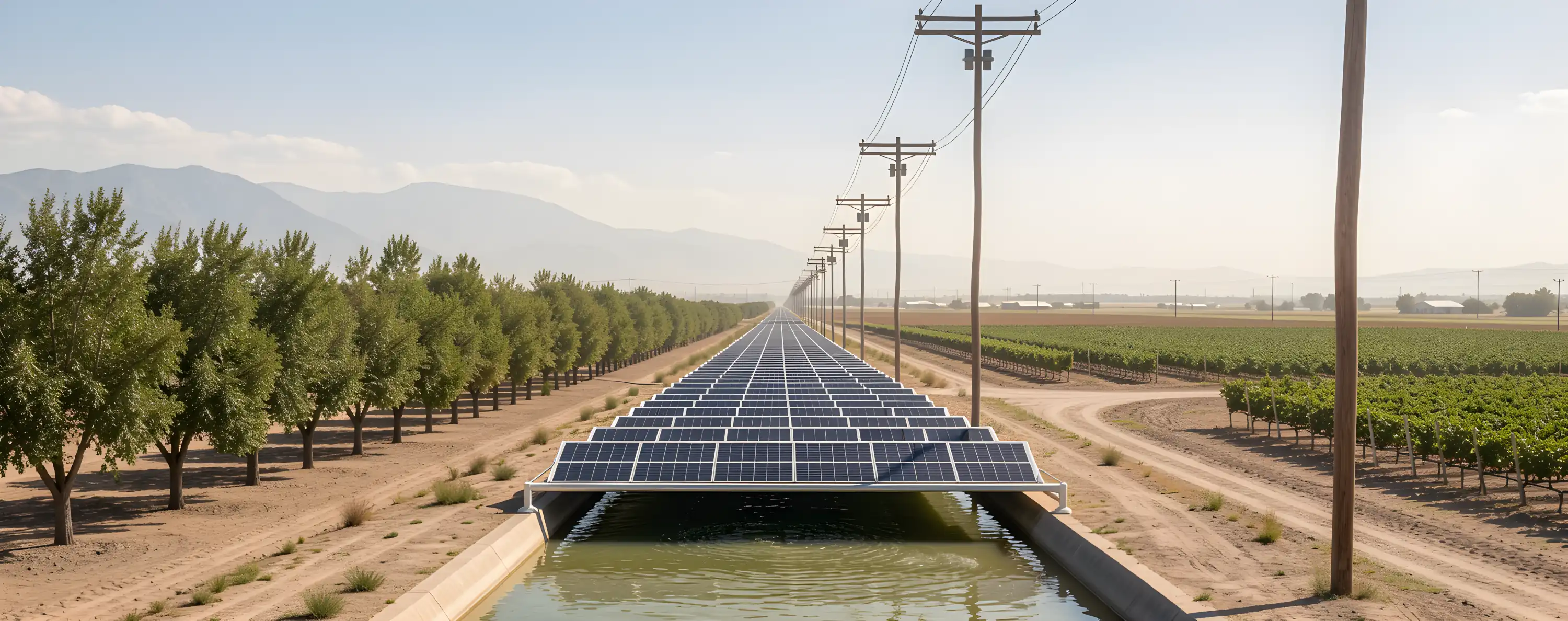

The Turlock canal pilot.
SOLAR WAVES was delivered from Sydney, Australia to Turlock, California, and deployed by a small team over a working irrigation canal. The result is a 60 kW solar array spanning a 6.5-metre-wide canal and running around 40 metres along it — generating clean power while shading the water below. This page follows that pilot: what it does, why canals matter, and how it was deployed.
SOLAR WAVES over the Turlock canals.
Over an irrigation canal in Turlock, California, SOLAR WAVES generates 60 kW of clean power from a single array that spans the 6.5-metre channel and runs around 40 metres along it.
By covering the canal, the pilot saves approximately 560,000 litres of water every year — water that would otherwise be lost to evaporation.
It was delivered pre-assembled, positioned onto a site-specific rail support, unfolded above the water, and connected — deployed by a small team rather than built on site.
Why this pilot matters.
An irrigation canal is working infrastructure. Turlock shows that SOLAR WAVES can add solar to that infrastructure without taking it out of service — and while improving it.
Covering the canal does more than generate power. At Turlock it: – saves approximately 560,000 litres of water a year by reducing evaporation, – protects the canal liner from direct sun exposure, – lowers the water temperature, – and reduces aquatic weed growth by keeping sunlight off the water.
And when the canal needs maintenance, the array can be unplugged, retracted, and packed together — clearing full access to the water below.
What the pilot demonstrates.
- 01.
Solar over working water infrastructure
The array generates 60 kW above a live irrigation canal, using the corridor that already exists instead of separate land.
- 02.
A site-specific rail support
The rail structure is the interface between the standard array and this canal; the array stays the same, the support is configured for the site.
- 03.
Access designed in
The array retracts and packs together so the canal can still be inspected and serviced.
- 04.
Delivered, not built
Shipped pre-assembled from Sydney and deployed by a small team: positioned, unfolded, connected.
- 05.
Measurable canal benefits
Water saved, liner protected, cooler water, less weed growth — proven on a real canal, not modelled.
Project benefits.
Power over water
60 kW generated directly over the canal — no separate solar farm and no additional land.
Water saved
Around 560,000 litres a year kept in the canal by shading the surface and reducing evaporation.
A healthier canal
Shade protects the canal liner, lowers the water temperature, and cuts aquatic weed growth by keeping sunlight off the water.
Cost below ground-mount
Supplied and deployed for less than the cost of a traditional ground-mounted solar farm — while preserving land.
Access kept
For maintenance, the array unplugs, retracts, and packs together, clearing access to the canal below.
Deployed, not built
Delivered pre-assembled and connected by a small team, rather than assembled from loose components on site.
How the pilot was deployed.
The Turlock array was delivered factory-assembled from Sydney, positioned onto the canal rail support, unfolded across the water, and connected — by a small team, on site.
- 01
Factory-assembled
MegaWAVE is assembled and pre-wired before transport.
- 02
Delivered
MegaWAVE is transported compactly to the project location.
- 03
Positioned
MegaWAVE is placed onto the rail support system configured for the canal.
- 04
Unfolded
The wave structure opens across the canal into its generating position.
- 05
Connected
Electrical connection and commissioning complete the deployment process.
Discuss a SOLAR WAVES project.
Speak with Green Energy Systems about pilot projects, site fit, canal infrastructure, support-system options, and deployment requirements.